
To learn more about other Robertsons in the Killin area in the 1700s, see The Robertsons of Killin page.
Please note that this page is currently subject to change. It was last updated on 19 April 2026 (previously 14 April).
This web page contains details about my 4 x great grandfather John Robertson who was recorded from 1779 living and working in a farming area known as Liangarstan in the area west of Ardchyle ('Wester Archyle'), south west from Killin in Scotland.
Finding details about John Robertson (and other Robertsons who lived in the Killin area) is complicated by the fact that several key record sets do not exist:
In the absence of these records, certain assumptions were made in the past about the relationships of various individuals. Some of these assumptions were proved wrong during 2025, based on new research and DNA results. In an interesting twist in early 2026, DNA research indicates that the Robertson male line is somehow linked with several men with the surname Campbell in the United States, suggesting that John could have been born to a Campbell man. Researchers in the United States have linked their origins to an Adam Campbell born in 1735 in Burnside of Balhaldie, north of Dunblane, Scotland. There is, unfortunately, no documented evidence to confirm this connection.
The details in the page below provide the details that are known about John Robertson, including a potential connection with Campbells.
The following diagram summarises the details on this page for the first five generations, for reference. The primary focus is John Robertson who married Ellin Clark (blue box) and their three sons.
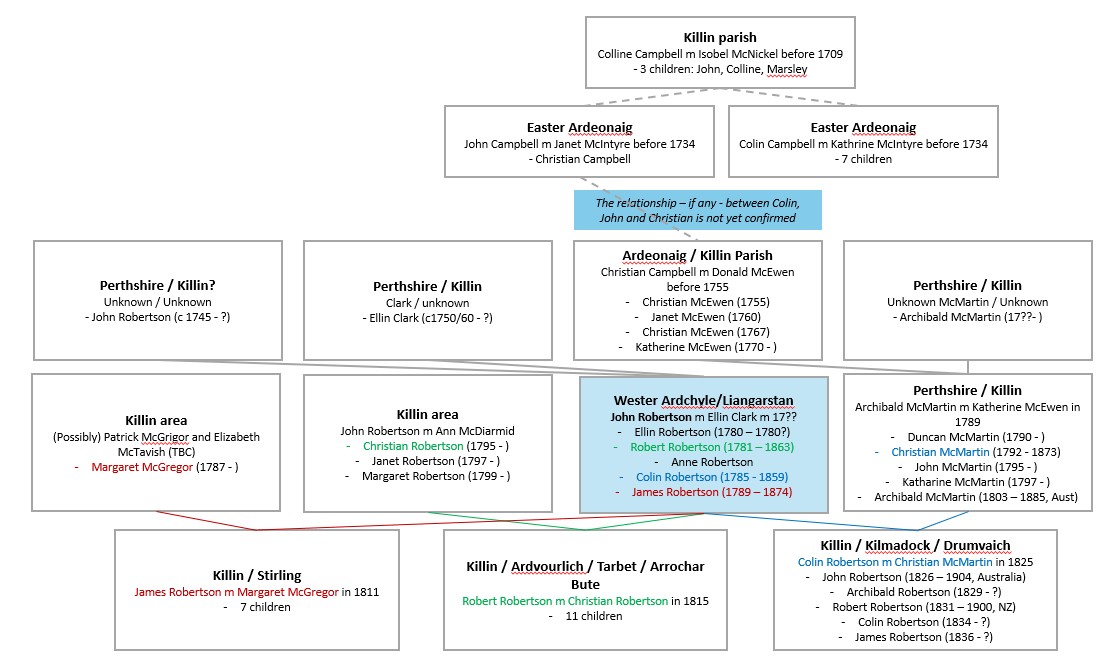
The page starts with details about the Campbells in the Ardeonaig area because of a potential connection between John Robertson and Campbells who lived in that area. It is worth understanding that the Campbell clan was made up of a 'main and chiefly' line of Campbell of Lochawe and multiple 'cadet branches' which, according to a page titled Cadet Branches of Clan Campbell on the website of the Clan Campbell Society of North America 'became in many ways clans in their own right'.
The above webpage notes that the Clan Campbell produced many lairds, 'heritable proprietors or land'; almost 300 cadet families in total. The webpage notes that 'a cadet branch consisted of the male-line descendants of a patriarch's younger sons (cadets)'. These included the Campbells of Ardeonaig and Lochend, the Campbells of Lix, the Campbells of Auchlyne and many others in the area around and to the west of Loch Tay where John Robertson first appears around 1779 (see the web page for more information).
We also need to note here that various tenants with the surname Campbell were also recorded in these areas. The relationship between these tenants and the Campbell cadet families (e.g., if some were the descendants of a Campbell) is not known.
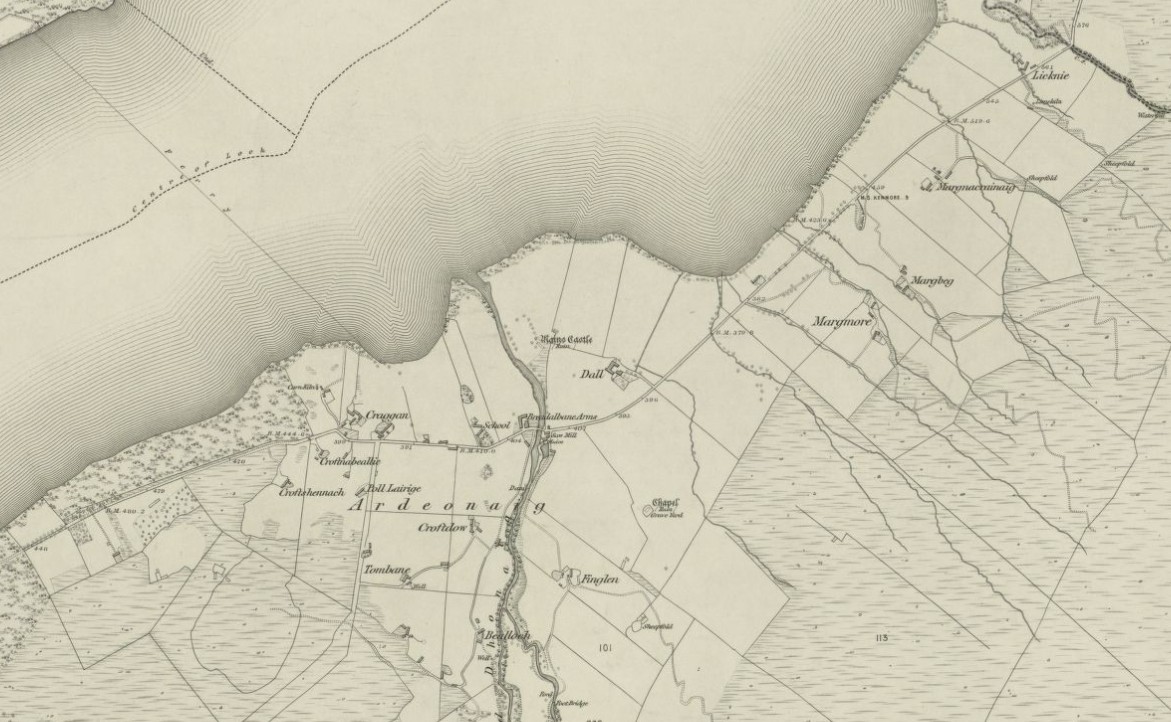
The Ardeonaig area in 1862. Note that a lot of the stone houses where tenants and others lived had already been demolished by this time. Source - Ordnance maps
The Campbell clan held extensive landholdings, including the entire area around Loch Tay at different periods in history. The (110 page) book 'The Lairds and Lands of Loch Tayside' by John Christie, published in 1892, relates in four pages the history of the Campbells in Ardeonaig. It notes that the land was originally held up to the 1400s by the Earls of Lennox. The Napier family then acquired the land through marriage. Sir Archibald Napier ('the father of logarithms') was the laird in 1587.
The book notes that '... from the Napiers the lands are said to have passed into the hands of a family of the name of Macgregor whose descendents held them until they were acquired by Alexander Campbell*, second son of Patrick Campbell of Murlaganbeg and Edinchip'. Patrick Campbell himself, the son of Sir Duncan Campbell (the seventh laird of Glenorchy**, one of the cadet families), was killed at Ardeonaig in 1661 in an encounter with a band of Macgregors.
*Alexander Campbell had married into the Glenlyon (family, 'his wife being a daughter of Captain Robert Campbell of Glencoe notoriety'.
**Glenorchy is just north of present day Dalmally on the river Orchy around 60 kms west of Killin.
Alexander Campbell transferred the land to his eldest son, Colin Campbell in 1720. Colin married Catherine, daughter of Campbell of Duneaves, by whom he had six sons and two daughters. Colin's eldest son John became a Captain in the army, and married Alice, the 'daughter and heiress of Campbell of Kilpunt'. Alice's younger sister (there was one other) first married Ewen or Hugh Campbell, Colin's brother. John Campbell's son, also John Campbell, eventually became Chamberlain of the 'Nether Lorn estates of the Early of Breadalbane'; he was said to have left a number of descendents.
The papers of the Campbell family at the National Records of Scotland (Ref GD112) contain many references to Alexander's son Colin Campbell. For example, they contain the following detail dated 29 November 1712: 'Instrument of resignation and sasine by Alexander Campbell of Ardeonaig in favour of Colin Campbell, his eldest son, and Catherine Campbell, youngest daughter of Duncan Campbell of Dunereaves, spouse of said Colin, in half lands of Ardewnane [sic], specified, in barony of Edinbellie by annexation in lordship of Discher and Toyer, sheriffdom of Perth' (Ref GD112/1/913). A reference dated 30 August 1766 refers to the death of Colin's wife, Kathrine McDuff (Ref GD112/2/8/187), who he appears to have married in 1710 (marriage contract Ref GD112/2/8/103), to whom he granted lands in 'liferent' from 1727 (Ref GD112/2/8/177).
According to the book 'Lairds and Lands of Loch Tayside', Colin 'appears to have got into monetary difficulties and had to dispose of his lands', some time prior to 1734, the same year that Wester Ardeonaig came into the Breadalbane family, 'having been excambed by Patrick Campbell of Barcaldine'. The Campbell papers refer to the debts relating to Colin Campbell's lands in February 1734 and the death of Colin Campbell's daughter in March 1734. These two events may have been the reason he decided to sell the property in late 1734. A letter dated 1734 from Colin to John Campbell, a writer in Edinburgh, states that because of the funeral of his daughter and other causes he must '... spend money and therefore wishes Lord Breadalbane's doers to make advances'. (Ref RD112/2/8/147). Multiple re-payments of debt are recorded from 1735.
The so-called 'ten-pound land' of Easter Ardeonaig included the lands of Succoch, Finglenhaugh, Ledchraggan 'and the twenty-shilling land of Carie'. The land was divided into the following 'possessions': Tomour, Succoch, Finglen, Tynaline, Twenty-shilling land, Ledchraggan, Margnadallich alias Dall, Croftdunard, Margmore, Margbeg, Margnacranag, Licknie and Aldvine, some which are visible in the ordnance survey map of 1862 above.
What about other Campbells on the land?
There is at least one reference to a tenant named Colin Campbell in the Campbell papers - on 4 January 1705, there is a reference to 'said tacksmen thair further Incuradgement for improving the saids Land' to assist in completing head-dyke begun by late Colin Campbell, tenant of said lands. (Ref GD112/2/92/1). As we will see below, there were various other Campbells in the Ardeonaig area.
The relationship between these other Campbells who lived in the Ardeonaig/Easter Ardeonaig area as tenants and the Campbell clan, if any, is not known. Killin Parish baptismal registrations show that a Colline Campbell and his wife Isobell McNickell had three children baptised in Killin from 1709 to 1713.

Baptism record for Johne Campbell in July 1709

Baptism record for Colline Campbell in March 1712
A John Campbell 'of the mill of Acharn' (at the eastern end of Loch Tay) married Janet McIntyre in Kenmore on 30 January 1729. (Ref 360 20/154), It is not known if John was the brother of Colin (immediately above) or if Janet was the sister (or other relative) of Kathrine McIntyre who married Colin Campbell - see below.

Marriage record for John Campbell and Janet McIntyre on 30 January 1729
John and Janet Campbell had at least two children baptised in Kenmore:
A girl named Christian Campbell, 'the legimate daughter of 'John and Jannet Campbell' was baptised in Killin on 27 October 1734 (Ref 361 10/121). It is not known if Christian was the daughter of the couple above; she is included here for two reasons: (a) a Christian Campbell from Ardeonaig married Donald McEwen in 1755 (see below), and (b) Christian and Donald McEwan's second daughter was named Janet (they had four daughters including two named Christian (which means the first died) and one named Katherine.
Several girls with a mother named Janet were born in this timeframe but none were named Christian:
Five girls named Christian Campbell were baptised in Killin from 1720 to 1738, the likely date range for her birth, but none of the women were named Christian.
A Colin Campbell married Kathrine/Katharen McIntyre from Easter Ardeonaig in Killin sometime before 1734, based on the birth of their first child in November 1734. Unfortunately no marriage record has been found yet for this couple in Perthshire. Kathrine may be the Cathrine McIntyre born to Finlay McIntyre and Jenet McCaile (recorded as NcCaile) on 27 October 1715 in Killin (Ref 361 10/65). She may be the sister (or other relative) of Janet McIntyre who married John Campbell, above.
Colin and Kathrine Campbell had the following children, all registered in Killin. Note the 9-year gap between their first and second children. As noted above, the land around Ardeonaig was sold around the time that Thomas was born.
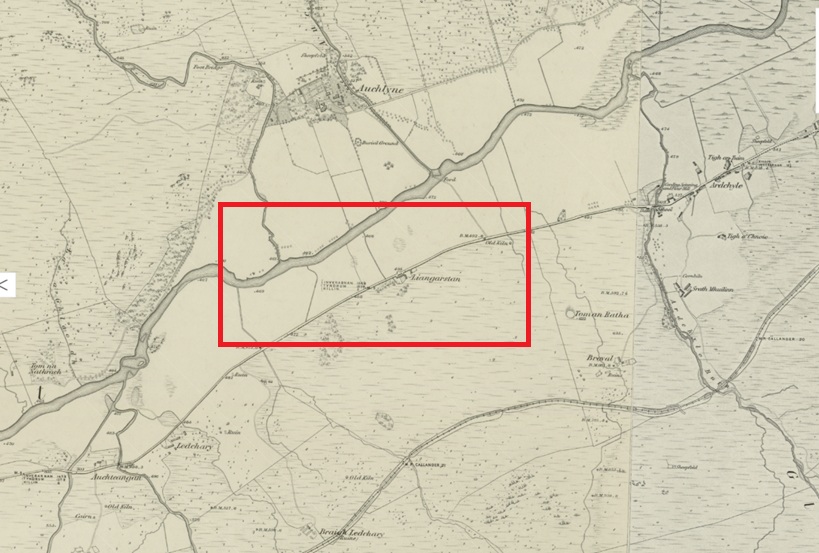
The area marked in red is believed to be where John Robertson and his family lived
According to page 72 of the book 'The Lairds and Lands of Loch Tayside', regarding the crofts of the Dewars on land that belonged to the McNab's: 'Within the ten-merk land of Auchlyne, which includes Wester Ardchyle, now called Liangarstan, there was Dewarnafergus croft, and in the twenty-shilling land of Suiie was Dewarvernans croft'.
John Robertson of Wester Ardchyle/Liangarstan is assumed to have married Ellin/Helen Clark by around 1779 in Killin, based on the date of birth of their first child - see below. The identity of Ellin/Helen Clark is not yet confirmed.
One theory has been that Ellin was the second daughter of Finlay Clark, a joint tenant farmer at Edramucky on the north side of Loch Tay who married Janet McIlduine / McIlGuine (presumed the same person) by 1752 (based on the birth date of their first child). Their children were:
At least one other Finlay Clark was recorded as the father of children during and after this period. It is assumed they may have been related somehow. Further research is required.
Donald McEwen married Christian Campbell from Ardeonaig, probably in Killin, sometime before 1755 which means she was likely born around 1735 as noted above. Unfortunately, there are no marriage records for Killin from 1717 to 1782 to confirm this, and Killin Kirk session records do not start until January 1771.
Donald McEwan's origins are not yet clear but it is noted that two boys named Donald McEwen were baptised in Killin in the likely timeframe that Donald was born:
Donald and Christian McEwen had the following children. Was Christian named after Donald's mother, as would have been the custom, or after Christian herself?
Donald McEwen may be the 'merchant in Killin' recorded in 'Scottish Highlanders' in 1775 [Source: Scottish Highlanders, page 30 (Ref GD112/11/1/2/8)]
John Robertson from Liangarstan was recorded as the father of a child baptised in Killin in 1780. As of mid-March 2026, it has not been possible to positively identify John Robertson from birth records in Killin. Based on the date of birth of his first child Ellin in 1780 (and maybe her death also the same year - see below), it is assumed that John was probably born sometime between 1740 and 1760.
Four boys named John Robertson were baptised in Killin from 1740 to 1761:
Unfortunately, there are no marriage records for Killin from November 1717 to November 1782, no church death records before 1855, and the Kirk sessions only start at 1771. This makes it difficult to identify what happened to each of these four boys/men or their parents (except for Robert and Janet Robertson nee Guild).
It has not yet been possible to identify if any of the above (except the one whose DNA does not match) is the same as the John Robertson who is the subject of this page, or if John came from a different part of Scotland. In this respect, a John Robertson was born on 24 September 1749 (Ref 390 10/54) to a Robert Robertson (no mother named in most of the registrations) of the Parish of Mullion, Redgorton, north of Perth.
One possible clue to John's origins could be in the names given to his children from 1780. If the couple following Scottish naming conventions, John's parents would have been Robert Robertson and Ellen/Ellin/Helen, while his wife Ellin's parents were Colin and Anne. Unfortunately, no obvious matches for either haver been found.
Was John Robertson born a Campbell?
Given the inability to positively identify John Robertson in birth records, could it be that his father was not a Robertson at all?
DNA research in early 2026 indicated that the Y-DNA of one of John's direct male descendants matched with several men in the United States with the surname Campbell. This raises the questions - was John Robertson born to a Campbell man, or was a Campbell born to a Robertson man? As at 12 April 2026, there is no documentary evidence that supports either question, but it may be worth noting that John and Ellin named their second son Colin, and Colin Campbell was a 'known' name in the area as the primary landowner. Other Campbells also appear, as shown in above diagram, and one has a connection with the Robertsons as we will see below.
John Robertson was a farmer, according to his son Colin's death certificate in 1859. John appears to have been living and working on the Campbell-owned land known as Liangarstan at Wester Ardchyle in 1779 when he is assumed to have married Ellen/Ellin/Helen Clark/Clerk or Clerick, date and location not known but probably by or during 1779, based on the date of their first child's birth in May 1780 (see below).
Killin kirk session records (1771-1806, reference CH2/1246/6) record that a 'John Robertson and party' paid 5 shillings 'for marriage on one proc(lamation)' on Thursday 6 August 1778. Given the other John Robertsons noted above, there is way of knowing which John paid for the marriage but the date would appear to align with the birth of children from 1780.
Who was Ellin/Ellen Clark?
Ellin may be the person with that name who was baptised on 16 July 1755 in Edramucky (Ref 361 20/19 - ?), the daughter of Finlay Clark and Janet McIlduine. Edramucky is on the mid-western side of Loch Tay. Finlay Clerk was recorded as a joint tenant farmer in 'Etramuckie', north side of Loch Tay, in 1769 [Source: Scottish Highlanders, page 15(SL#21)]. However, if John and Ellin followed Scottish naming conventions, the names of Helen's third child (second son) and fourth child (second daughter) would have been Colin and Anne, not Finlay and Janet, which casts some doubt as to whether she was actually the daughter of that couple. But it raises the question - if Colin was not Ellin's father, where did the name come from? Who was Colin?
NOTE: Coincidentally, a John Robertson married a Helen Clark in Fordoun, on the east coast of Scotland south of Aberdeen on 27 March 1768 (Ref 259/20/25). No birth records have been found for this couple anywhere in Scotlands People. The only birth records found relating to a couple by the name of John Robertson and Ellin Clark are the ones below in Killin from 1780. Given the existence of a record of a John Robertson paying the local church for a marriage ceremony to be carried out in 1778, it is more likely that the couple were from the local area.
Children born to John and Ellin Robertson
John and Ellen Robertson had the following children who were all baptised in Killin.
Birth records for Robert, Anne and James shows the family at Wester Ardchyle or Liangarstan. The family was recorded at Liangarstan when Ellen and Colin were born.
Two points to note:
It may be worth noting here that John Robertson of Margowan (near Killin) was a regular recipient of funds from the Killin church in 1788 and 1789. The identity of this John Robertson is not known.
Archibald McMartin and Katherine/Catharine McEwen, 'both of the Parish of Killin' were married in Killin on 25 April 1789 (Ref 361 10/283). The Killin kirk session records notes that on 3 May 1789, 'Archibald McMartin and party' paid for marriage 'on one proclamation'. No birth record has yet been found for Archibald McMartin, but it was a common surname in Killin for children born from 1750 to 1760, the timeframe when he was likely born. Various McMartin people appear in the Kirk session records from 1788, including Margaret McMartin from Tirai and Janet McMartin from Duncrosh in August 1788.
Only two Archibald McMartin births have been found in Scotland's People from 1730 to 1775 anywhere in Scotland, as noted below. Both would have been much older men if they married in 1789 - not impossible but unusual. If he was from Inverary, the obvious question is what was he doing in the Killin area? Further research is required.
Katherine was the daughter of Donald and Christian McEwen - see 'From 1755' above. .
Archibald and Katherine had the following children:
By the late 1700's, more forced evictions were occurring. Lieutenant-General John Campbell (30 March 1762 - 29 March 1834), the 1st Marquess / Marquis of Breadalbane, and a Scottish soldier and landowner, became the Earl of Breadalbane in January 1782. In 1792 many families were forced to leave for the coast and many others emigrated. This might explain why John's son's Robert, Colin and James left the area and moved to different locations.
James Robertson(8 September 1789 - ?), the son of John Robertson and Ellin/Helen Clark, married Margaret (Mary) McGregor on 10 February 1811 at Killin (Ref 361 10/332). Given the names of their third and fourth children, it is possible (but not confirmed) that Margaret McGrigor was the daughter (with the surname as shown) of Patrick McGrigor/McGrigor and Elizabeth McTavish and was born on 31 August 1787 in the Killin area (Ref 361 20/220); she had a brother named Patrick McGregor who was born 10 May 1802 also in the Killin area.
James and Margaret Robertson had the following children:
The fact that all their children were baptised in Killin suggests they lived in that area until at least 1825. However, James and Margaret Robertson and their children have not yet been found in the 1841 census - but James appears in the 1851, 1861 and 1871 census in Stirling. Further research is required. Their daughter Christian and her husband Angus McNab appear in the 1851 census in the Glasgow area.
Robert Robertson (1781 - 1863) was the son and second child of John Robertson (1744 - ?) and Ellen/Ellin/Helen Clark or Clerick (baptised 16 July 1755, Edramucky - ?). Robert married Christian Robertson (baptised 14 April 1795, Tirarthur, Killin, Scotland (Ref 361 20/270) - 11 June 1870, Rothesay, Bute, Scotland) on 30 November 1815 in Killin (Ref 361 10/339), the daughter of John Robertson and Anne McDiarmid. Her siblings were Janet Robertson (born 13 February 1797) and Margaret Robertson (born 26 June 1799), both baptised in Killin.
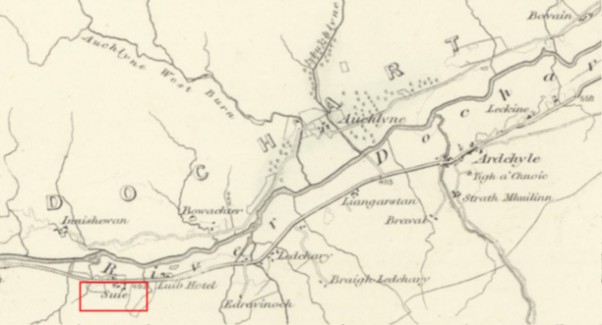
Suie, west of Liangarstan, in 1866. Source - Ordnance maps
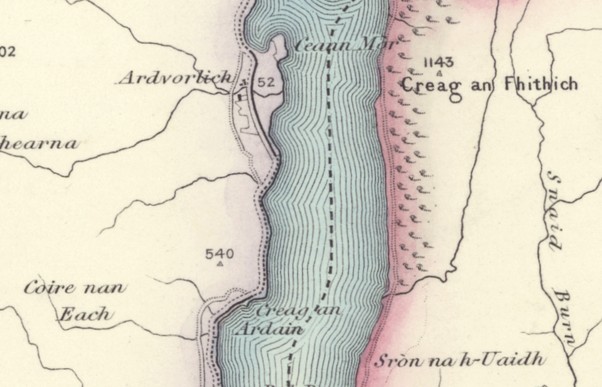
Advorlich, on the western side of Loch Lomond, in 1866. Source - Ordnance maps
Robert and Christian Robertson had the following children. Their birth locations indicate that the family moved westward:
We see this family again in the 1841 census in Dunbarton - see below.
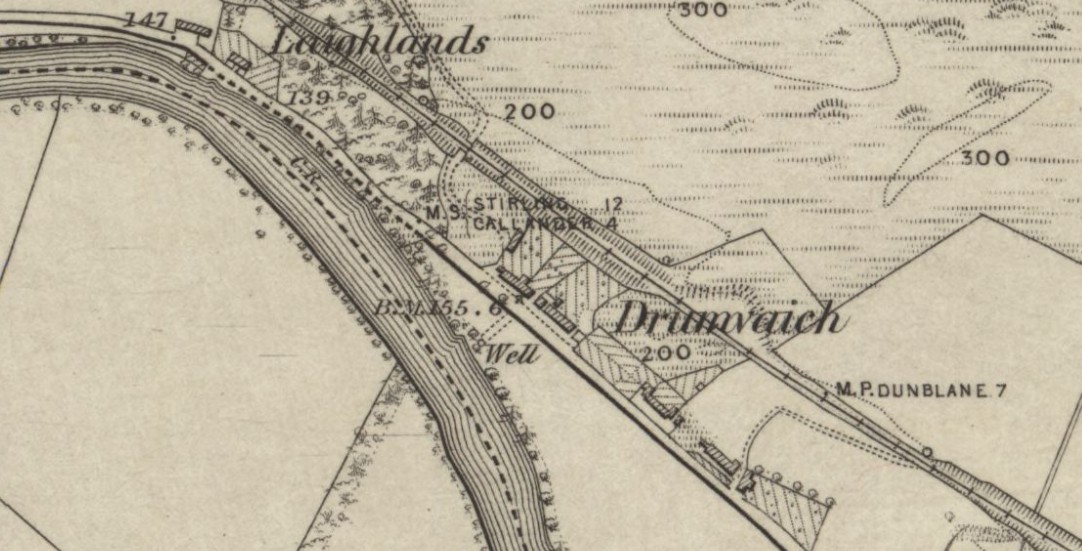
The Drumvaich area in 1866. Source - Ordnance maps
Colin Robertson (born 1785) had moved to a farming area known as Drumvaich, north west of Doune by 1825. At the age of 40, Colin Robertson declared his intention to marry the 32-year-old Christian McMartin (bap 24 June 1792 (Ref 361 20/252), the daughter of Archibald McMartin and Katharine McEwen - 1873) on 31 December 1825 in Kilmadock Parish (containing the settlements of Doune, Deanston, Buchany, Drumvaich, and Delvorich). They married on 13 January 1826 in that Parish (Ref 362 50/262).
Colin and Christian Robertson had the following children, all born in the Doune area:
According to a history of the Village of Killin by Ella Walker, the death of John Campbell in 1834 'heralded a time of great hardship and sorrow for many of his humble tenants'. His son, the 2nd Marquis, did little to manage the estates and instead left the Estate to the care of his Factor, a Mr James Wyllie, 'a name long remembered with dread in Breadalbane'. According to the history, Wyllie cleared the tenants from several parts of the Estate to make room for the formation of large sheep farms, often using means 'of great cruelty and injustice'. This may have started from the early 1800's and continued after the death of Campbell. Many of the original farm houses were destroyed (which might be why they don't appear on ordnance maps in the 1860s). The remains of old stone farmhouses remain scattered around Loch Tay to this day.
The 1841 census records the following individuals noted on this page:
Kilmadock area / Drumvaich village (Ref 362/1/7)
Their son John Robertson (born 1826) was not present. He was 15 or 16 by then and could be one of many young men with that name and age in the 1841 census. He may have already left the area and headed south before travelling to Australia. Colin and Christian's other two sons, Colin Robertson (aged 7) and James Duncan Robertson (aged 5), also do not appear in the census and no obvious record has been found of them after that point. Had they died by that point? Or were they just not recorded?
Alva / Stirling (Ref 470/2/13)
See below from 1848 for details of the migration to Australia of Archibald McMartin and family and his nephew John Robertson.
Kilmadock area / Malton (Ref 362/2/1)
South Adrvorlich, Arrochar / Dunbarton (Ref 492/3/1)
Arrochar is to the west of Loch Lomond.
Robert and Christina's children Colin (born 1822), Janet (born 1825), Anne (born 1827), and Donald (born 1829) are not listed with their parents in the 1841 census which means they had either died by then or were living elsewhere. A James Robertson (aged 50) and his likely wife Christian (aged 50) and a probable son James Robertson are also recorded at Arrochar in the 1841 census (Ref 492/1/7); it is not yet known if they are related.
Robert's family is listed as shown below:
Over the next 10 years it appears that all of the children had moved away from home except Christina who was aged 11 when recorded in the 1851 census, see below. Robert also appears to be working elsewhere as he is not recorded in the same location as his wife Christina (recorded as the 'wife of a shepherd') in the 1851 census.
Stirling/Stirling (Ref 490 7/11)
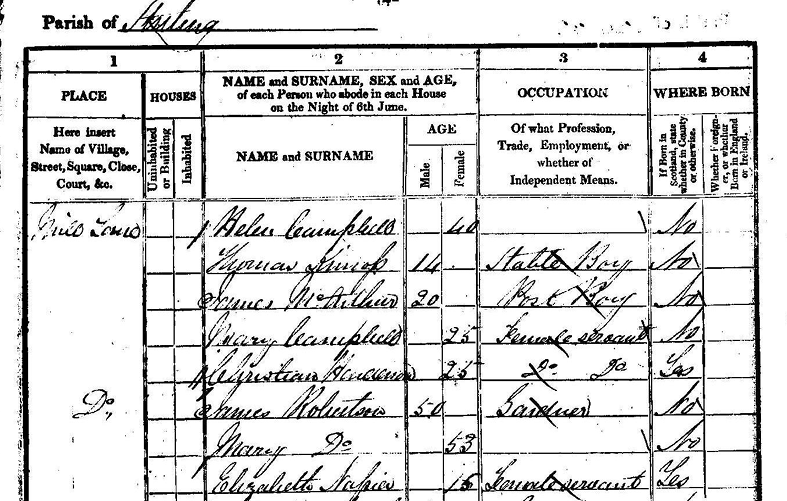
James and Mary Robertson
James Robertson (aged 50, the brother of Colin and Robert above), a gardener, and his wife Mary (aged 53) are recorded in the 1841 census in Stirling with a 15-year-old female servant named Elizabeth Napier. It is believed this is the same couple as the ages shown are consistent with the ages of James Robertson born in 1789 and his wife Margaret/Mary (nee McGregor) who may have been born in 1787, but the 1841 census did not record where they were born. Their location in the 1841 census appears to be 'Guild' or 'Mill' Lane or something similar.
Archibald and Jean McMartin and their children, along with Archibald's nephew John Robertson, left for Australia on 9 November 1848, arriving at Port Philip (Melbourne) on 12 February 1849 on the (relatively new, 635 ton ship) Frances Ridley. See John's story for further details of the family in Australia. The shipping record lists Archibald McMartin as a labourer; his sons Archibald, William and Hugh were recorded as 'farm labourers'. John was recorded in the 'Single Males, not being members of families', as a 'wheelwright' from Drumvaitch, Perthshire.
Colin Robertson - Drumvaich (Ref 362/1/3)
The 1851 census shows Colin Robertson (now aged 67) and Christian (aged 59) at number 12, Drumvaich, a small village. The census notes that Colin was born in Killin, Perthshire, and that Colin was now a 'Labourer and occupier of 2 acres arable and 1/8 part of 150 acres of common' (Ref 362 1/3). They appear to be living alone. The location of their children in 1851 is summarised below:
Robert and Christian Robertson (Ref 492/3/3)
Robert Robertson (born 1781) the brother of Colin Robertson in Drumvaich, was a shepherd. In the 1851 census, Robert's wife Christian Robertson (aged 55, a 'shepherd's wife') and their daughter and youngest child also named Christina (aged 11, a scholar), were recorded at 8 Ardverlick, Dunbarton, just north-west of Glasgow in the Parish of Arrochar along with a lodger named Robert McDougal (aged 11, also a scholar).
It is assumed that Robert himself was in a different location working as a shepherd. There are at least seven Robert Robertsons aged between 69 and 71 in the census including one Robert Robertson, said to have been born in 1786 (aged 65) recorded as a shepherd and servant to Alexander McKerracher, living at Gatur, near the Port of Monteith. Gartur is around 40 kms away from where his wife Christian was living.
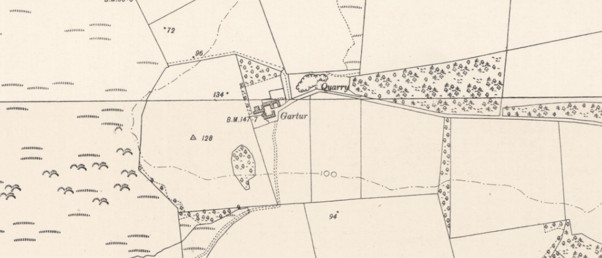
Gartur, Port of Monteith in 1866. Source - Ordnance maps
James Robertson (born 1833) - Duchlage
Robert and Christian Robertson's son James (born 1833), now aged 17, was recorded at Duchlage.
James Robertson - Stirling
The 1851 census records a James Robertson (aged 60), a shoe maker born in Kilmadock (not Killin), Perthshire, living with his *sister* Mary, a widow aged 45 and recorded as a housekeeper. This James is NOT believed to be the brother of Colin and Robert Robertson.
In 1854, Colin Robertson wrote a letter in reply his son John in Australia (full text below below). This letter appears to confirm that only John and Robert were alive at that point. He mentions that John's aunt is very happy to hear some news about Duncan McLean in Australia. He makes mention of 'uncle Archibald' who would seem to be overseas somewhere and doing very well. It is not clear who Archibald is; Christian's father was Archibald McMartin but none of their known children were so-named; none of John's brothers were named Archibald. One possibility is the Archibald McMartin who was born to Malcolm McMartin and Margery McDiarmid and baptised in Killin on 9 August 1791 (Ref 361/20/247). This couple had at least two other children but their marriage record has not yet been identified.
John noted in his letter that he had written to John's brother Robert (possibly in Newcastle) but had not received a reply. He added that Robert '... likes the English masters better than the Edinburgh Masters' and that he will 'stop in Newcastle all summer'. He also added that Robert was keen to go to Australia also but didn't have the money to do so. Note also the reference to an Uncle Archibald, highlighted in bold and italics. It is not known who this is.
Drumvaich
June 14 1854
Dear Son and Daughter and all your friends there,
It is with the greatest of pleasure at this time that I sit down to write to you these few lines to let you know that we are all in ordinary steat of health (Thanks be to God for his grate Murcy towards you and us) I hope that this will find you and all friends there injoying the same blessing, we thank you for being so mindful of writing to us, we received your kind letter deated th28 January it landed us th24 May it took as long a time is any I have yet it came with the ship Australian, you anty is very happy to hear that Duncan Maclean and his wife are both in good health shee thanks you kindly for being so mindfull of sending us word about them, she thinks a wounder that they not got any of the letters shee send I think shee send two or three letters shee is in hopes by there last letter that they soon be home with great fortune as they mention in there last letter that they expect to to be home this summer. --- we received three letters from you since the beginning of January last this is the forth one I send three letters before this one I wrote you answer for each of them, in case you have not got them and we return our kind thanks and love to you for your kindness to us in the time of need in sending us ten pounds we hope that you will want and trust that you will be more richera after this nor ever you been before; with God blissing; we pray that the lord will bliss you a Spiritual blissing from on high with a long life and prosperity and we all praice him for his goodness towards us at all times. --- you (?) in your letter about your Uncle Archd*, how he is coming on nor nothing about his Famley. we here from other people that he is doing will and that he is worth a great deale of money, whether this is true or not we Cannot tell you. We are very glad to here that you have got your houses ready and that you have let one of them to a tenant from our own parish if it is true, David Dewar John Dewar's father had been telling to sume of his friends that John his son and Henderson hi(?) taken a house in Geelong from John Robertson Colin Robertson's son, it was Hohn [sic, perhaps John] Macnee in Coil bo halzie in the braes of Doune, had told me (?.) John will tell you aout him, old David Dewar is married on John Macnee's sister -- I am very happy to here that our own countrey people is so friendly to one another in a strange countrey and they ought to be so among strangers. -- I am very happy that John is goten his houses re(ady?) which I hope that they will pay him good interest for his money as I am told there is nothing that will pay better than building houses in Australia, but am quite sure that they coast you a great deale of money however we will let that alon, if a farmer was to look on all expences on his farm he would never put a plour on his land, so I would advise my man to build houses or by land there, as I am informed them people is bying and selling houses or land that they are doing well and sell with great profit; - I hope that John has built his houses secure that the wind will not blow them down lick sume of your churches (.) John Dewar's Father was telling me one day that your Church was blow down with the wind and that Henderson and John was two of the Committee of the Church lickwise that he thought that John was the (?) and the church was to be built anew, so if it be true I hope that John would see it properly built for the Congregation a false built Kirk is very dangerous I have to build a new byre this summer on my own expences I get nothing from the propraitors but the wood the old byre in nearly to the pot, I am afraid that it will fall su(?) night or day on the cows I rather build it anew myself ner to be danger only cost me about 25/- - perhaps I will get something for building sume time yet.
*Uncle Arch'd is probably Christian's younger brother who was born in 1803 in Balquhidder.
I have a lamentable tale to tell you that conserning Duncan Campbell o(ur) next neighbour he had been working at a road between Lock Katrine (and?) Lock Lomond left Coulbarn Inn on saturday night th6 of May it would seem that he had been drinking two freeley he was missing for sume time, after a diligent search has been made for him without suckcess at last on the 6 of June his body was found by men that was fishing in the loch. Loch Katrine. he has left his wife and 6 children to morn his loss the poor widdow is left without anything but the nei(ghbour) gives her I have gathered by superscription near 30/- it will keep the famley at the mean time Dear Children I have better let you know we have a sabbath teaching in our house since the month April ether aout 15 or 16 children on every sabbath evening James Buchnanan chos teaching the first ch(ild?) Betsy Buchanan for the second class, Jean has one from Easter Choclchat teaching the 3 class. I realy think it is doing a great deal of good to the young children, it is a great blissing to teach in the fear of God when they are young they will mind it when they (are) old --- I have wrote to Robert when ever I received your letters I have not got an answer back from him yet, the last letter we got it was the month of May th4 of that month he steated in his letter that he likes the English masters better than the Edinburgh Masters he say that the Englosh [sic] masters is not so proud and they are more kinder that he will stop in Newcastle all summer Robert was very willing (to) go after his brother but passage money was so high that he could not go except he would get some assistance I give his a copy of all letters that you send, he thinks a wounder that John is not writing to him at all he had wrote to John two or three letters and he had not got no answers back, tell John to write himself to him, although they are fare distant from one another let them keep brotherly love, I trust in God that they will love one another, in doing so they will be lick brothers: My dera [sic] daughter see yourself what manner of love you send to us in your own letters, it is true what my wife said when I read your letter and tears falling to the ground, what manner of lo(?) she said, I think my daughter it is at our own fireside speaking to face to face, although you is in Australia and we in old Drumvaich. Dear children the Gospel is very true, love goes over all - our time is but a spang length in this world so let us consider our ways how shall we come to God for we are sinful creaturs, Jesus said I am the way, no man cometh unto me but by the Father, him that cometh to me I will in no wise cast out, come to him and he will save you from all distresses. I am now getting old I think my age is 73 the 4th of this month your John was born the 19th Nov 1826 so you can count his age yourself I think it is 28 years coming. Robert was boren the year of our Lord 1831 the 5th Aprile his eage 23 years past, Now my I am noe near at close with my letter, I hope we are journeying unto (a) place of which our Lord said, I will give it you, Come thou with us and we will do thee good. The Lord bless thee and keep thee The Lord make (his) face shine upon thee and be gracious unto thee May the Lord lift up (his) Countenance upon thee and give thee peace and in the kingdom of God ( .. ) Eternity- remember and write to us all the news how you are comming especially about your houses, my wife and friends joins me in our kind love to your all and may the Lord bless you all Your loveing Father till death.
Colin added the following page to the letter:
Talking nonsense
By the bye after ending my letter my sister* came and said that shee would wish vry much that you would write to Duncan Maclean** that shee send 4 letters to them since they left home, and that shee is wearing for another letter from them shee address her letters to the care of the man that Duncan wrought to a place called Edinburgh House in Geelong, no if you know the place where he is you can write him. I have a little more to say Andrew Maclean and John Maclean*** went off Australia in the month of Apeile last John was very ill off when he saw the shipe some lady told me that he fainted very ill. for aw that he took a wife with him they were saying that they would no face Duncan nor speak to him for what reason I cannot tell you, when they will land there they will be among the Cold to the shoulders. I have something more to tell you. My wife and I is very throung howing wtthe potatoes just now, they are looking very well. it apears they will be a crop in Scotland this season for everthing looks well. everything is rising in price since this ware commenced between Turkey and Russia, meal is selling at £2-13- per load, and every other accordingly; I must draw this letter to a close for want of room if I be supared in health I will write soon again, may the Lord bless you all mind us in your prayers your Father and Mother
C.R.
Remember and write soon again.
*It is not clear whether this refers to either of Colin's sisters Ellin (who may have died at birth) or Anne (about whom) nothing is yet known, or to Christian's sister Katharine who may have married a Colin McLaren (TBC).
**The name Duncan MacLean comes up again when Colin's brother Robert died in Stirling in 1874 - a Duncan McLean, Robert's 'nephew in law' was the informant.
***Victorian shipping records show that Andrew McLean (aged 26) and John McLean (aged 24), both 'farmers', left Liverpool on the 'Mermaid' on 1 May 1854 with almost 400 other passengers, arriving a couple of months later. Andrew McLean was probably the man whose death was recorded in The Evening Star (Ballarat) on 15 January 1914 'deceased arrived from Scotland in 1854 and after a short spell at the (gold) diggings entered into farming at Learmonth', eventually becoming the proprietor of the 'old Harvest Home Hotel' but then acquiring another farm adjoining Labona and lived there with his family. That article notes he was 88; the Victorian BDM record (Ref 691/1914) states he was 82 with both parent's names unknown. He married Mary Paterson/Patterson (who died around 1910). They had four children:
Robert Robertson (born 1831), the son of Colin Robertson (died 1859), married Mary Sked at Tradeston in Glasgow in 1856 (Ref 644/98). Mary Sked may be the person of that name, born to Richard Sked and Margaret Campbell, baptised on 9 January 1823 in Glasgow (Ref 644/1 310/172). If this is correct, Mary had a younger brother, Richard Sked, baptised 18 April 1830 in Greenock Old (25 miles west of Glasgow) (Ref 564/3 50/297). Robert and Mary Robertson had two children, neither of whom survived a year:
The death location for Colin suggests that Robert and Mary Robertson (nee Sked) returned to Doune, perhaps because his father was dying, or to help his mother.
Robert and Christian Robertson were photographed in the late 1850s.
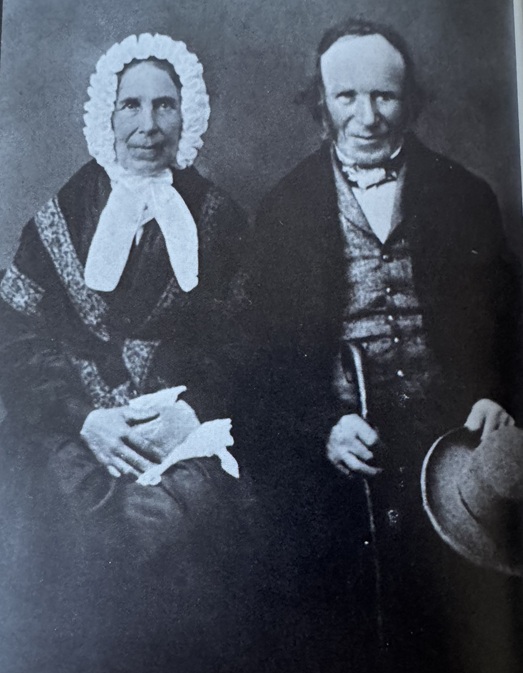
Source - Descendant of Robert and Christian Robertson
Colin Robertson, an agricultural labourer and dyke builder, died on 13 June 1859 aged 74. His father was recorded as John Robertson (decd.), farmer and his mother was Helen Clark (decd). This information was notified by Robert Robertson, his son. Colin was buried at Doune Churchyard (probably Scots Church, which was sold to private developers in 2012 - his grave is no longer identifiable).
Following the death of her husband Colin, Christian Robertson, along with her son Robert Robertson and his wife Mary Robertson (nee Sked) migrated to Australia. They departed Liverpool as unassisted passengers on board the British Trident on 9 January 1860, arriving in Melbourne, Australia, on 5 April 1860. The emigration to Australia and Colin's letter above seems to indicate that none of their children remained in Scotland (but John's brother Robert was living in Rothesay, Bute).
It is likely that they were met by Christian's son (and Robert's brother) John Robertson, on arrival. Christian died in Geelong on 12 May 1873. Click this link for more information about Robert Robertson in Australia and New Zealand.
Rothesay, Bute - Robert and Christina Robertson - (Ref 558/18/18)
Robert Robertson (born 1781, now aged 80, a 'former shepherd'), the son of John Robertson and Helen Clark (aka Ellen Clerick) and brother of James Robertson in Stirling, along with his wife Christian (nee Robertson, mother's maiden name McDiarmid, now aged 65) are recorded at 2 Minister's Brae, Rothesay, Bute, Scotland in the 1861 census. They had two boarders in their home - Mary Buchan, aged 42, a factory worker from Ayreshire, and Janet Watson, aged 26, also a factory worker from Glasgow. (Ref 558/18/18)
Stirling, Stirling - James Robertson - (Ref 490/6/21)
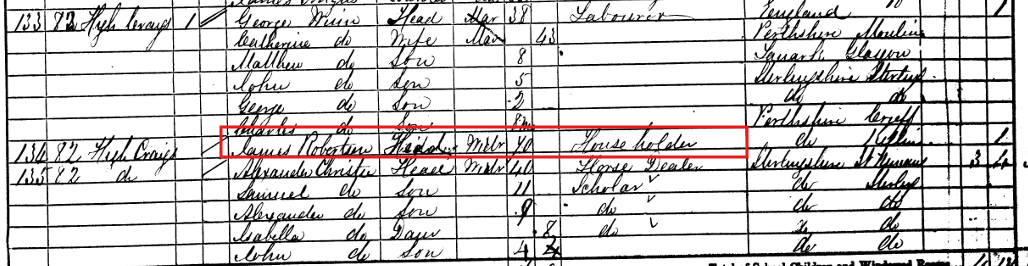
James Robertson in the 1861 census in Stirling
James Robertson (born 1789, now aged 72), the son of John Robertson and Helen Clark (aka Ellen Clerick) and brother of Robert Robertson in Bute, is recorded as the 'house holder' at 82 'High Craigs' (possibly now Upper Craigs Street) Stirling in the 1861 census (Ref 490/6/21). If it is the same location as Upper Craigs presently, most of the houses are three-storeys high. This would explain why there appear to be three families at this address - the family of George Minn (6 people), a labourer, and the family of Alexander Christie (5 people), a horse dealer. James himself appears to be living on his own. He may have moved by the 1871 census (see below) which records him at what looks like 63 King Street, Stirling.
Robert Robertson (born 1781), the son of John Robertson and Helen Clark, died on 10 June 1863 at Rothesay. His death certificate states he was 83-years-old and a shepherd, and he was the son of John Robertson, a farmer, and Helen Clark (both deceased). The cause of his death was 'paralysis', possibly a stroke. The informant was his daughter Margaret (born 1836); her surname is not clear. (Ref 558/72).
Robert's wife Christian (nee Robertson, mother's maiden name McDiarmid) died on 11 June 1870, also at Rothesay, Bute, Scotland (Ref 558/109, first name shows as Christina).
James Robertson - Stirling/Stirling - (Ref 490 7/30)
James Robertson (born 1789), the brother of Colin Robertson and Robert Robertson, is recorded in the 1871 census at 63 King Street, Stirling as follows (Ref 490 7/30). Note that the writing is quite poor:
The daughter Catherine above was born in 1809 but James married Margaret McGregor in February 1811 at Killin and their first child Margaret was baptised there in April 1811.
Duncan McLean - Stirling/Stirling - (Ref 490/14/8)
A Duncan McLean (aged 46, born about 1825 in Stirling, a quarryman) and Ellen McLean (aged 39, born about 1832 in Southhampton, England) are recorded in 57 Lower Bridge Street, Stirling in the 1871 census (Ref 490/14/8). This was a three-storey building that still exists. Could this couple be related to James Robertson who died in 1874? See below.
James Robertson was the son of John Robertson and Helen Clark, and the brother of Colin Robertson and Robert Robertson who pre-deceased him.
James' death certificate states that he died on 3 March 1874 at 34 Haig? Street in Stirling. His death certificate states was 84, a 'scavenger' and 'widower of Mary Livingston' [sic]. His parents were recorded as John Robertson, a farmer, and Helen Clark (same as Colin and Robert). He died of 'senile decay'.
The informant on the death certificate was Duncan McLean of 79 Upper Bridge Street, Stirling, noted as a 'nephew in law'. (Note the Duncan McLean noted in the 1871 census was living at 57 Lower Bridge Street; it's possible they moved to the Upper Bridge Street address between 1871 and 1874).
To be a 'nephew in law' means he was likely the husband of the daughter of James' brother Robert (as brother Colin didn't have daughters); these daughters were Helen/Ellin Robertson (born 1820, Janet Robertson (born 1825), Anne Robertson (born 1827), Margaret Robertson (born 1836), and Christina Robertson (born 1839). Noting the 1871 census reference to Duncan McLean and Ellen McLean, could this be the daughter of Robert Robertson?
Page updated 14 April 2025, created 18 October 2025 from the original created in December 2011. Copyright © Andrew Warland. (andrewwarland(at)gmail.com)